
Cosmo Was Right All Along
Barrett Edri
February 23, 2026
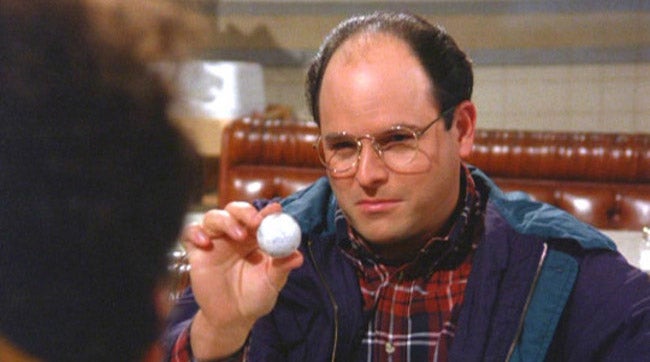
Kramer knew the rules. Gendason didn't. A whale paid the price. This is a golf article.
There is a man who understands golf better than most of us ever will. He never took a lesson. He never wore a glove. He never once talked about his handicap at a dinner party, though, to be fair, he was usually too busy pitching a coffee table book or managing a chicken roaster business. His name was Cosmo Kramer. And he was right. About all of it.
Now, stick with me here. Whether you're a seasoned golfer who knows the difference between a provisional ball and a lateral hazard, a Seinfeld fan who never once picked up a club, or someone who recently wandered into a golf store and thought, "how hard can it be?", this one's for you. Because buried beneath the hair, the technicolor shirts, and the inexplicable success with women, Kramer was quietly showing us what golf is really about. And more importantly, what life is really about.
The Man, The Myth, The Five Iron Let's start at the beginning. Or rather, let's start at a trunk full of golf balls on the way to Rockaway Beach.
In one of the more criminally underrated subplots in Seinfeld history, Kramer tries to convince Jerry and George to join him at the beach, not to swim, not to sunbathe, but to stand at the shoreline and drive golf balls into the ocean. Jerry and George, being Jerry and George, pass. Sensible men. Rational men. Men who would later hear about what happened and be very grateful they stayed home.
Because Kramer went anyway. Alone. He loaded up the trunk with balls, drove himself out to Rockaway Beach, and did exactly what he set out to do. And for a glorious moment, it worked. The balls arced over the waves. The sea stretched out like a vast, uncomplaining driving range. There was no rough, no sand trap, no marshal in a cart telling him to keep pace. Just a man, a club, and the Atlantic Ocean.
And then came the whale.
A beached whale. Clogged, it was later revealed, with golf balls. Kramer's golf ball. A Titleist.
"The sea was angry that day, my friends, like an old man trying to send back soup at a deli."
If that line doesn't already live rent-free in your head, you may want to re-examine your priorities. But here's the thing: most people remember that story as a punchline. A classic Kramer disaster. Another beautiful catastrophe in a long line of them. What they miss is the subtext. The man was practicing. Maniacally, obsessively, on his own terms. He found a range that cost nothing and had no tee times, and he hit until the world pushed back. Hard. In the form of a whale.
That's golf. That's always been golf.
"I Don't Want 'Em!" Then there's the clubs.
If you've played golf, even once, you know the moment. You're standing over the ball. You've visualized the shot. Everything feels right. You draw back the club with the confidence of someone who has absolutely no idea what they're doing, and then... you skull it forty yards into a bush. Or you chunk it so badly the divot goes farther than the ball. Or, and this is the one that really gets you, you hit it almost perfectly, almost, and it still doesn't do what your heart told it to do.
Kramer felt this. Deeply.
In a moment of pure, unfiltered athletic frustration, Kramer walks into Jerry's apartment, drops his clubs on the floor with a magnificent crash, and announces, simply: "I don't want 'em!"
No explanation needed. No lengthy debrief. Just the universal language of a man who has been defeated by a small white ball and needs everyone in the room to bear witness.
Every golfer alive has had this moment. Most of us just don't have the self-awareness, or the dramatic flair, to act it out properly. We mutter. We stew. We put the clubs in the garage and tell ourselves we'll get back out there in the spring. Kramer, to his eternal credit, made it a scene. He committed to the emotion. He honored the game by acknowledging how mercilessly it can break you.
And then, like every true golfer, he was probably back at the range by Thursday.
The Rules of Golf, As Defended by One Cosmo Kramer Now we get to the heart of it. The moment that separates Kramer from every casual Sunday hacker and reveals him for what he truly is: a man of principle.
The incident with Steve Gendason.
For those who need a refresher: Kramer is playing a round of golf with Steve Gendason. At some point during the round, Gendason picks up his ball to clean it, before reaching the green. This is, by the Rules of Golf, not permitted. Under the rules, a player may lift and clean their ball only when it is on the putting surface, and only after marking its position. Picking it up mid-fairway, or wherever Gendason committed this violation, is simply not allowed.
Kramer calls it. He holds Gendason accountable.
Most of us wouldn't. Most of us, playing a casual weekend round, would look the other way. We'd chalk it up to etiquette, to not wanting to be that guy, to just keeping the peace and moving on to the next hole. Golf, after all, is supposed to be relaxing.
But Kramer understood something that we've conveniently forgotten in our age of "it's just for fun" and "we're not keeping an official score anyway." The rules exist for a reason. You cannot have a game, or a society, for that matter, without rules. The moment you allow one person to pick up their ball whenever they feel like it, you've undermined the entire enterprise. What's next? Improving your lie in the rough? Nudging the ball away from the tree root with your foot? Forgetting to count that first swing because it was "just a practice stroke"?
This is the slippery slope. Kramer saw it coming. He drew the line.
And yes, Gendason later went on a rampage. Someone got hurt. The cause, when traced back, was that single moment on the course when a man was told, for perhaps the first time in his life, that the rules applied to him too. That's not Kramer's fault. That's Gendason's fault. Kramer didn't create the instability in the man. He merely revealed it, the way a good round of golf always does.
Golf is a mirror. It shows you exactly who you are.
Why Golf Has Rules (And Why That Actually Matters) Here's something that gets lost in the handicap discussions and the debates over which shaft flex you need and whether you should be playing a blade or a cavity back: golf is the only major sport in the world where the players are expected to call penalties on themselves.
There's no referee watching every shot. No review official trailing you on the fairway. If you ground your club in a bunker, if you accidentally move your ball at address, if your caddy stands on the line of your putt, you're expected to know, and you're expected to call it. The integrity of the game depends entirely on the integrity of the person holding the club.
That is remarkable when you think about it. In a world where we have instant replay, pitch clocks, VAR technology, and full-time officials for virtually every other sport, golf still operates on the honor system. It assumes that you are honest. It assumes that you value a true result over a flattering score.
And most golfers do. That's the beautiful, slightly insane truth about this sport. Most people who play it seriously will take a penalty they didn't have to take, call a rule on themselves that no one saw, and card a score that's a stroke or two higher than it would've been if they'd just kept quiet. They do this because they understand that a fraudulent score is worth less than nothing. It's not a score at all. It's fiction.
Kramer understood this. He didn't just play golf. He believed in golf.
The Company You Keep on the Course There's an old saying among golfers that you learn more about a person's character in one round of golf than you would in years of casual acquaintance. Watch how they handle a bad bounce. Watch what they do when no one's looking on the fourth hole of a back nine on a Tuesday morning. Watch how carefully they count their strokes.
Golf exposes people. The rules exist not just to make the game fair but to create conditions under which truth is unavoidable. When you cheat at golf, you're not just cheating your playing partner or the field. You're cheating yourself, and everyone watching can see it, even when you think they can't.
A "foot wedge" here. A conveniently improved lie there. Somehow making a birdie on a hole where you watched the ball go into the water. A golf cart parked on the green because your knees hurt, or your back, or because the rules simply don't apply to you the way they apply to everyone else.
People notice. People always notice. And here's the thing about someone who cheats at golf: what exactly are they telling you about themselves? If a person will look their own scorecard in the eye and lie, if they will cheat themselves of an honest result, in a game, where the only thing at stake is their own integrity, what won't they lie about? What line, exactly, won't they cross when the stakes are higher?
Think about that the next time you see a man driving his cart across the green, nudging the ball with his foot, and telling everyone within earshot about what a tremendous golfer he is. What a tremendous winner.
There's a word for that kind of golfer. Several words, actually.
Cosmo Knew Here's where we land, after all of it, the beached whale, the abandoned clubs, the righteous enforcement of the ball-cleaning rule. Kramer wasn't just a guy who liked golf. He was a guy who took it seriously in a world that kept telling him not to take anything seriously. He played by the rules when it was inconvenient. He felt the losses when they came. He walked away from the game in a moment of passion and came back to it because you always come back.
And in doing so, he modeled something we could all stand to remember: that how you play the game says everything about how you live. That integrity isn't situational. That the rules aren't just suggestions for people who feel like following them today.
Some of us came to this realization through years on the course. Some of us came to it through a television show about nothing.
And some of us, watching a man drive his cart across the green, rake his ball out of the rough with a casual foot, and post a score that defies all known physics, some of us are just now figuring out how right Cosmo really was.
All along.
Foresome.com, Golf for everyone. Especially Seinfeld fans.
Written by
Barrett Edri
Co-Founder, Foresome