From Feathers to Physics: How Golf Equipment Went From Handmade to Otherworldly
Barrett Edri
June 4, 2026
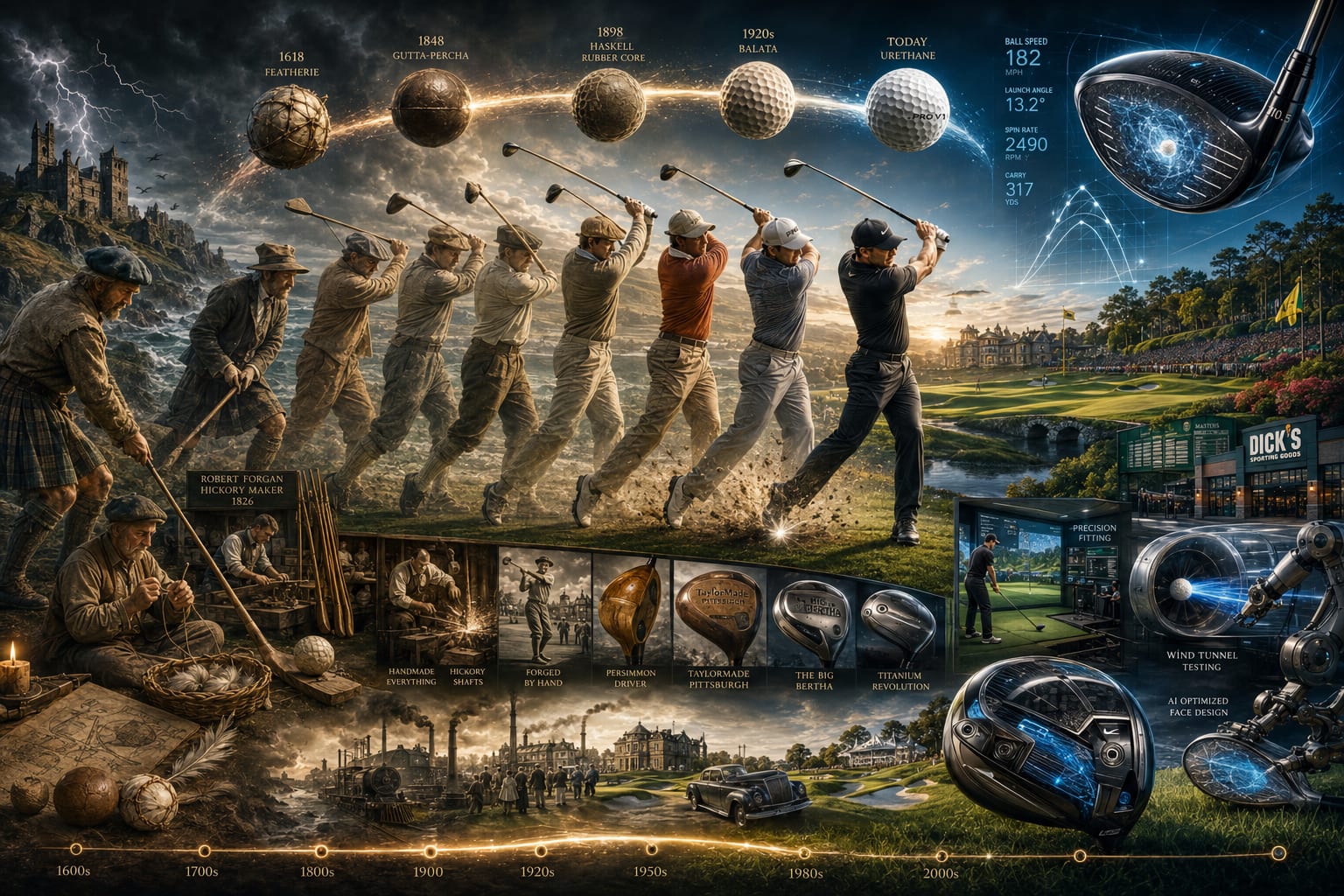
A single feathery ball once cost more than the clubs that struck it. Today a full set with an AI-engineered titanium driver waits at Dick's for $299. Five centuries of obsession, and the only thing that never changed was the game itself.
There is a man in 17th century Scotland standing on a windswept stretch of linksland, holding a club carved from a single piece of wood, preparing to hit a ball stuffed with goose feathers. The ball cost more than the club. It will last, with any luck, one full round before the elements destroy it. He has exactly one of them.
There is a man at a Dicks Sporting Goods in 2025 loading a full set of cavity-back irons, a 460cc titanium driver with an adjustable hosel and an AI-optimized face, and a dozen urethane-covered, multi-layer golf balls engineered in a wind tunnel into his cart for $299. The set comes with a bag.
These two men are playing the same game. That is the most remarkable thing about this story, and also, depending on your perspective, the most absurd.
Act One: The Ball Came First
Golf equipment history does not begin with clubs. It begins with the ball, because the ball determined everything else. The clubs you could use, the courses you could build, the game you could play, all of it was downstream of whatever sphere you could manage to put into the air.
The earliest golf-adjacent games used wooden balls carved from hardwoods like beech and boxwood. Functional, cheap, and completely terrible. The wood did not compress. It did not spring. It did not do anything a golf ball is supposed to do except maintain its shape, which it managed admirably. The shot experience was roughly equivalent to hitting a rock with a stick, which was more or less the point.
Then, in 1618, the featherie arrived. It was cowhide stuffed with goose feathers, and the manufacturing process was so exacting that a skilled craftsman could produce three or four in a day at most. Both the leather pouch and the feathers were wet during construction, which was the trick: as the leather dried and shrank, the feathers dried and expanded, compressing together into a ball harder and more aerodynamic than anything that came before it. The featherie flew. It was also extraordinarily expensive, often costing more than the clubs used to hit it, and it dissolved in rain with the enthusiasm of a paper bag. For two centuries it was the standard, which says less about how good it was and more about how difficult it is to improve on something when the people who make it have a vested interest in keeping things exactly as they are.
The gutta-percha ball ended that arrangement in 1848, and it ended it so decisively that the featherie essentially vanished within a generation. The guttie, as it came to be known, was made from the dried sap of the Sapodilla tree, could be heated and molded into shape, and could be mass-produced in quantities that made the featherie era look like a cottage industry. It was cheaper, more durable, and more consistent, and it hit the market the same way any genuinely better product hits the market: it made the previous generation of craftsmen furious and then irrelevant.
There was one unexpected discovery along the way. Golfers noticed that their gutties flew better as they accumulated nicks and scratches from use. A new ball was actually a liability. This observation, which must have been confusing and inconvenient when it was first made, eventually led ball manufacturers to intentionally texture the surface with patterns that improved aerodynamic performance. The dimple was not invented so much as discovered, by accident, through the simple act of paying attention to what the ball was doing.
In 1898 Coburn Haskell introduced the rubber core ball, wrapping tightly wound rubber thread around a solid rubber center and encasing it in a guttie shell. It flew further than the guttie by margins significant enough to matter and was still cheap enough to produce at scale. By the early 1900s the guttie was gone and the rubber core ball was the template everything since has been built upon. The core became solid. The cover became Surlyn, then urethane. The dimple patterns were optimized for spin rates and launch angles and swing speeds that the 17th century Scotsman with his handmade club could not have imagined and would not have known what to do with. But the fundamental architecture Haskell established at the turn of the last century is still recognizable in every ball being played on the PGA Tour today.
Act Two: The Clubs Catch Up
The clubs took longer to evolve because they were always chasing the ball.
The longnose clubs of the early era were exactly what the name suggests: long, narrow wooden heads designed for a sweeping, low-to-the-ground motion, built to work with the unpredictable flight of whatever ball was available. They were made from ash or hazel shafts, the heads carved from harder woods like beech or apple, and they had roughly the structural integrity you would expect from something designed before metallurgy became a science. Skilled golfers treated their clubs the way you might treat a antique watch. Which is to say, carefully, and with the quiet anxiety of someone who knows they cannot be replaced.
Iron clubs existed but were rare and avoided in the featherie era for a sensible reason: the irons would destroy the ball on contact. When the guttie arrived and demonstrated that a golf ball could survive being struck by metal, iron clubs became viable almost overnight. By the 1870s, drop-forging techniques had advanced enough to allow factory production of iron clubheads at scale, and the handmade era of club-making began its long decline.
Robert Forgan began making shafts from imported American hickory in 1826, and hickory became the dominant shaft material for a century. It had real advantages. It was strong, relatively consistent, and available in the quantities the game now required. It also had a significant amount of torque, which meant the clubface could twist considerably during the swing and golfers had to accommodate that movement as part of their technique. The hickory swing was shaped by hickory's limitations as much as by any intention.
Steel shafts arrived in the 1920s and the R&A legalized them in 1929. The USGA had already done so the year prior. Steel eliminated most of the torque and produced a shaft that behaved more predictably under load, which changed the mechanics of the swing more fundamentally than any other single equipment change until titanium. The golf swing you see on television today, the upright plane and the rotation through the ball, is partly a product of what steel shafts made possible once hickory and its inherent flex were removed from the equation.
Persimmon wood drivers ruled the fairways through most of the 20th century, prized for their feel and their sound and the fact that the best players had learned to extract maximum performance from a sweet spot roughly the size of a half dollar. They were beautiful objects, honestly, in the way handmade tools often are. TaylorMade introduced the first metal wood driver in 1979, a stainless steel head called the Pittsburgh Persimmon, which was either a tribute to what it was replacing or a monument to the confidence of a company that believed the name alone could carry the transition. The tour professionals mostly ignored it. The recreational golfer, who had never developed the precision required to consistently find a persimmon sweet spot, did not.
Then came Callaway.
In 1991, Ely Callaway named his new stainless steel driver after a World War One German howitzer because he believed, correctly, that it would hit the ball farther and straighter than anything else on the market. The original Big Bertha had a 190cc head. The USGA maximum today is 460cc. By 1991 standards it looked enormous. The larger sweet spot was not an aesthetic choice. It was a statement: golf equipment does not have to punish you for a slightly imperfect strike. Four years later Callaway introduced the Great Big Bertha in full titanium at 250cc and sold over 250,000 drivers in the first year. TaylorMade followed immediately with its own titanium driver and the arms race was fully underway.
Titanium changed everything it touched. Because titanium is lighter than steel relative to its strength, engineers could redistribute weight around the perimeter of the clubhead, lowering the center of gravity and expanding the effective sweet spot to a size that would have seemed like science fiction to the persimmon era. They could make the face thinner at the center and engineer it to flex and rebound at impact, transferring more energy to the ball. They could make the head larger without making the club unswingable. The gap between what an expert golfer could do with a persimmon and what a recreational golfer could do with a modern titanium driver narrowed in ways that the game had never experienced. Equipment had always rewarded skill. For the first time it was actively compensating for the lack of it.
Graphite shafts, which had been available in various forms since the 1970s, became genuinely viable performance options through the 1990s as manufacturing processes improved. Lighter than steel, they allowed for faster swing speeds without requiring additional physical strength. The combination of titanium heads and graphite shafts produced clubs that recreational golfers could swing meaningfully faster than anything available to their parents, and the distance gains that resulted were real, measurable, and permanent.
Act Three: The Game Had to Move
Here is where it gets interesting.
Golf courses are built for the equipment of their era. When the guttie replaced the featherie, courses that had been adequate suddenly played shorter and the architects had to respond. When Haskell's rubber core ball flew further than the guttie, it happened again. Every significant improvement in ball or club technology has eventually forced a reckoning with the physical spaces where the game is played, and the titanium and urethane era produced the most dramatic version of that reckoning the game has ever seen.
Augusta National, the most famous golf course in the world, has added over 500 yards to its length since 1934. The 13th hole, a par five that Jack Nicklaus once reached in two with a three-iron, is now regularly reached in two with a pitching wedge by the longest hitters on Tour. The governing bodies have responded by adding length to championship courses, which costs enormous amounts of money, which means the arms race between equipment manufacturers and golf course architects has been running continuously for thirty years with no obvious end in sight.
The USGA and R&A spent the better part of a decade arguing about what to do about it. The result, announced in 2023 and taking effect for elite competitions in 2026, is a Model Local Rule that allows tour events to require limited distance golf balls, rolling back average driving distance by roughly 14 to 15 yards for the longest hitters. The ball on the first tee at your club this Saturday is not affected. The ball on the first tee at Augusta National in April may be. The governing bodies effectively split the game into two tiers: one where the equipment arms race continues unchecked for recreational golfers, and one where the elite game attempts to return to something resembling the strategic challenge the courses were designed to present. Whether this holds or whether it is simply a pause before the next technological leap is a question nobody can answer honestly.
Act Four: The Door Opens
All of this brings us back to the man in the Dick's Sporting Goods parking lot, which is where the story actually ends.
Because the thing that titanium and graphite and urethane and cavity-back irons and every other technology of the modern era produced that matters most is not the distance. It is not the optimization. It is not the reduced spin rates or the increased moment of inertia or the AI-generated face architecture that Callaway now uses to engineer its drivers. It is access.
A single featherie golf ball in the 1700s cost as much as an entire set of clubs. That one fact tells you everything you need to know about who was playing golf in the 1700s. The guttie was the first democratizing force in equipment history. The rubber core ball extended it. The mass production of steel clubs through the early 20th century extended it further. But the modern era of golf equipment, for all the criticism it has absorbed for making the game too easy or the ball too far or the course too irrelevant, has done something no previous era managed to do: it has made a genuinely functional set of golf equipment available to anyone who wants one, at a price point that does not require a conversation with a leather craftsman who can make four balls a day.
That full set at Dick's, the one with the cavity-back irons that forgive the slightly off-center strike and the driver with the sweet spot the size of a small country and the graphite shafts that make the thing feel like it might actually cooperate with you on this particular morning, that set represents five centuries of accumulated human ingenuity applied to the problem of making this specific, beautiful, infuriating game accessible to the person who showed up on the first tee without a membership card or a family legacy or any particular reason to be there except that something called to them and they answered.
The 17th century Scotsman with his featherie and his longnose and his clubs that cost less than his ball could not have imagined the equipment sitting in the average golfer's trunk in 2025. But he would have recognized the game immediately. The walk between shots. The silence before the swing. The honest conversation between a person and themselves conducted on a piece of land that does not care who made your driver or what you paid for it.
The equipment changed. The game did not.
That is worth something. That might be worth everything.
Written by
Barrett Edri
Co-Founder, Foresome