
The Wrong Decision: Why LeBron to Philly Is Bad for Basketball and Golf
Barrett Edri
July 24, 2026
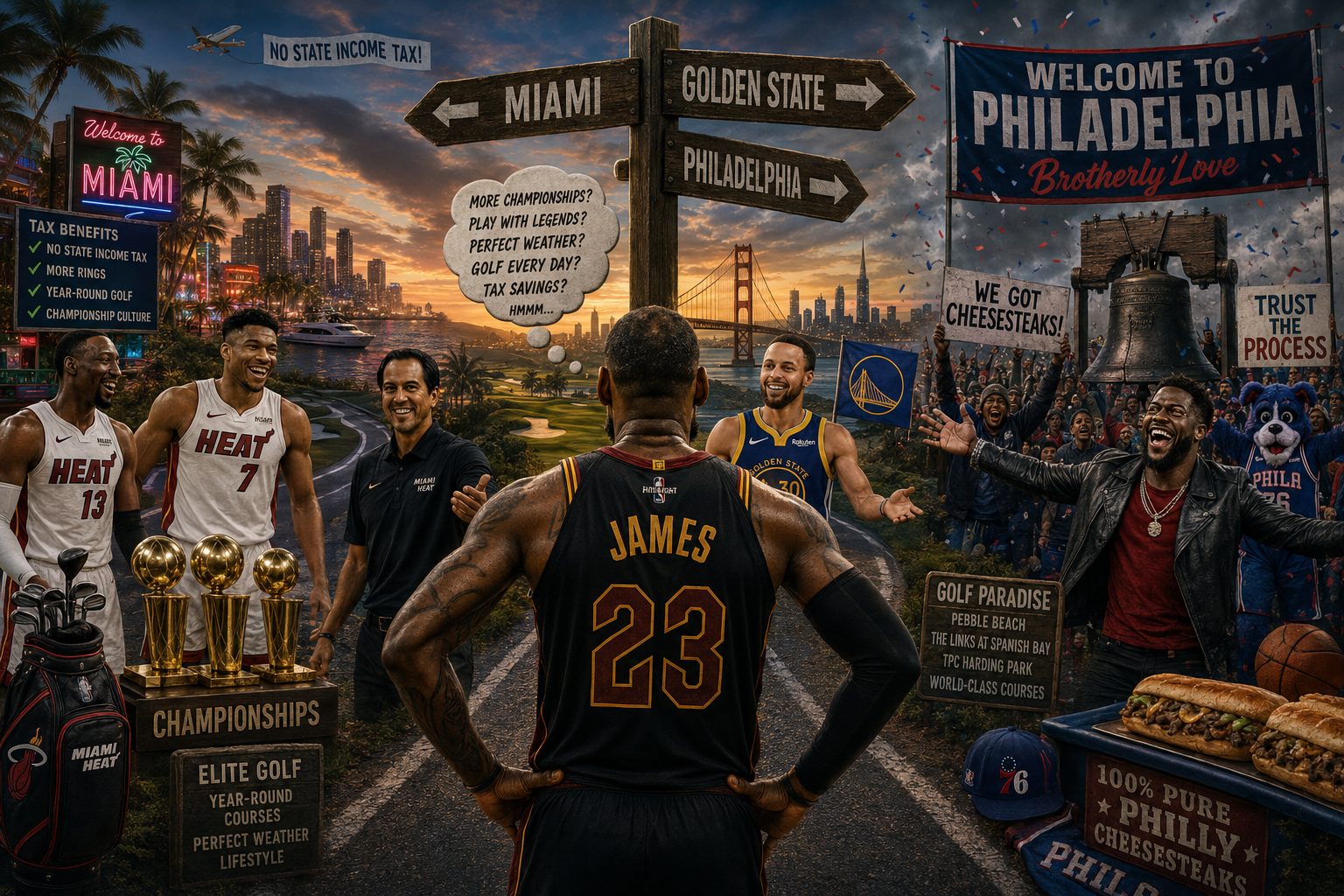
LeBron had Miami's storybook ending, a Cleveland homecoming, and a dream fit next to Steph Curry on the table. He picked Philadelphia, and doomed us to two more years of the LeBron–Kevin Hart golf rivalry.
LeBron James just made what he called his "last decision," and he made it in Philadelphia. On paper, joining Joel Embiid, Tyrese Maxey, and newly-acquired Jaylen Brown looks like a real title swing. Underneath the surface, it is arguably the weakest of the four paths in front of him, and for those of us who care about the game of golf just as much as the game of basketball, it might be the worst outcome of all.
Miami was there. Cleveland was there. Golden State was reportedly trying to trade for Anthony Davis specifically to lure him. James picked the one option that ranks last in shooting, last in health certainty, last in golf weather, and, worst of all, keeps him locked in a golf rivalry with Kevin Hart that neither man is remotely equipped to carry. Here is the deep dive on all four, basketball first, then the part that actually matters most to us.
Let's Start With the Real Tragedy: The Golf
Before we get into shooting splits and defensive ratings, we need to talk about what this decision means for the sport we actually cover.
LeBron and Kevin Hart have spent the entire summer trading jabs about their golf game, from clubhouse trash talk to LeBron trolling Hart with a set of junior golf clubs to Hart going on national television calling LeBron a cheater after a round together. It has been entertaining. It has also been, by every account, rough to watch. Neither man is walking off the course anytime soon threatening a scratch handicap, and now that LeBron has picked Philadelphia, the two of them are staying attached at the hip for at least the next two years, with a home course, a rivalry, and apparently a standing tee time that isn't going anywhere.
We love that the game is pulling in more attention from athletes and entertainers at this level. We do not love watching two guys who are still figuring out where the clubface is at impact turn their process into a public spectacle every few weeks. So here is our official, only slightly joking request: stay in the basement this winter. Both of you. Get on the simulator, put in the reps, and do not resurface until the swing looks like something other than a survival exercise. If you need a role model, look no further than your own family, LeBron, because Bronny is already playing better golf than either of you, and Bryce isn't far behind him. Let the next generation carry the torch while the two of you work on your fundamentals in private.
It is a genuinely good thing for the sport when guys like this fall in love with golf. It is a genuinely rough thing for the rest of us who appreciate a clean swing to watch it happen in public before the games have caught up to the passion.
Now, on to the basketball, which is really where this decision falls apart.
1. Miami: The Storybook Ending That Got Left on the Table
LeBron James became a champion in Miami. Twice. He walked away from South Beach in 2014 with unfinished business, a Big Three that never fully cashed in on its ceiling, and a fanbase that has spent over a decade wondering what could have been. Coming back now, as a 41-year-old chasing one final ring, would have been the single greatest redemption arc the modern NBA has ever produced.
It also would have been the best basketball decision, full stop.
This offseason, Miami traded for two-time MVP Giannis Antetokounmpo, pairing him with All-Defense anchor Bam Adebayo. That front court alone is one of the most switchable, rim-protecting, high-motor pairings in the league. Add Andrew Wiggins and Davion Mitchell on the wing, both plus defenders who can guard multiple positions, run it through Erik Spoelstra, one of the most respected coaches of his generation, under Pat Riley's front office, the most decorated executive infrastructure in the sport, and you get a roster where every single starter is capable of switching one through five and holding their ground.
The shooting critique of this roster is also overstated. Bobby Portis shot 45.6 percent from three last season, second-best mark in the entire league among qualified shooters. Andrew Wiggins shot 41.4 percent. Tim Hardaway Jr., a fresh addition, shot 40.7 percent and led all reserves in threes made. Davion Mitchell, once a below-average shooter in Sacramento and Toronto, has developed into a legitimate weapon in Miami's system, sitting near 39 to 41 percent from deep depending on the stretch of the season. Simone Fontecchio has shot at a respectable clip as a spot-up threat, and Nikola Jovic posted a career-best 37.1 percent from three before injuries limited his season, while Pelle Larsson quietly ran one of the most efficient offensive seasons of any young guard in the league. That is five or six real shooting threats already on the roster before LeBron even arrives, not the shooting-starved team the outside narrative suggests.
Miami was not done there. Reporting throughout the summer had the Heat expressing strong interest in Klay Thompson, holding preliminary talks with Bradley Beal's camp, and viewing DeMar DeRozan as a real option, all shooting or scoring upgrades layered on top of an already switchable, shot-making roster. Russell Westbrook was even in the mix, though reportedly only as a fallback if LeBron did not sign there, which tells its own story about how those two view a potential reunion. If Miami lands even one of Thompson, Beal, or DeRozan, it still finishes ahead of Philadelphia in defensive versatility, three-point shooting depth, bench quality, and front office pedigree. That is how large the gap actually is.
Miami did not stop at free agency, either. In this year's draft, the Heat traded up to grab Louisville guard Ryan Conwell, a bona fide sniper who launched 9.6 threes a game as a senior and shot better than 40 percent on clean catch-and-shoot looks. Miami's own front office said afterward that Conwell projected as a top-percentile shooter among the hundreds of players they studied ahead of the draft. It is exactly the kind of pick the Heat have made before, in the same mold as Duncan Robinson and Max Strus, two players nobody else valued who Miami's system turned into legitimate playoff shooters. Betting against Miami's shooting development track record at this point is a losing habit.
That matters enormously for a 41-year-old LeBron. He would not have needed to be the engine of the defense or the number one option offensively. He could have plugged into a system where Giannis and Bam Adebayo absorb the two-way burden, Wiggins and Mitchell lock in on the perimeter, and LeBron simply facilitates, picks his spots, and conserves his legs for the moments that matter most. Everybody else on that roster shares the same identity and the same focus. That kind of alignment is exactly what wins championships late in a star's career, not one more year of being the engine, but the ability to plug into a machine that already runs well without him.
Add in the parts that have nothing to do with basketball. Florida has no state income tax. Miami has golf courses open 365 days a year. It is the one market on this list where LeBron could have chased a ring and his golf handicap at the same time, without a single tradeoff.
Miami was the total package. Championship pedigree, defensive culture, elite three-point shooting, year-round golf weather, and zero state income tax, wrapped in a storyline Hollywood could not have written better. It is the clearest missed opportunity of the four.
2. Cleveland: Home, With One Enormous Hurdle
Cleveland is where it all started, and there is a real emotional pull to finishing a career back where it began, especially after Cleveland delivered the city its first championship in over 50 years in 2016 against a 73-win Golden State team. That story alone makes Cleveland worth taking seriously.
The roster case is real too. Cleveland had the best regular season of any of James's four options in 2025-26, a 52-30 record and a trip to the Conference Finals, and they proved mid-season they will make bold roster moves, trading for James Harden in February.
That trade is also the single biggest problem with this option.
Harden is one of the most prolific isolation scorers the league has ever seen, and his game has always leaned toward one-man possessions rather than ball movement. He holds the Guinness World Record for most consecutive unassisted points scored by a single player in NBA history, 304 points across seven games in January 2019, a stretch where he was, quite literally, playing basketball almost entirely on his own. That is close to the opposite of the read-and-react, pass-first style that wins in May and June, and it is the opposite of the identity LeBron has spent his whole career trying to build around him.
Harden was never the whole story, though. Reporting throughout the summer had Cleveland exploring exactly the kind of blockbuster that would have solved that problem. One version had the Cavaliers pursuing Kyrie Irving, either in a Harden-centered deal or by moving other pieces once Harden's contract situation opened a path, reuniting Irving with LeBron nearly a decade after the two won a title together in Cleveland. A separate scenario had Cleveland offering Evan Mobley to Washington for Anthony Davis, another former LeBron champion, which would have left a starting five of Donovan Mitchell, Irving or Harden, LeBron, Davis, and Jarrett Allen still anchoring the paint. Either version of that roster would have been a legitimate storybook contender, a homecoming built around two of James's actual championship co-stars rather than a ball-dominant scorer who has never quite fit the way he plays winning basketball.
Even setting all of that aside, and taking Cleveland's roster exactly as it stood with Harden still in the fold, the case for Cleveland over Philadelphia is not close. Best record of the four, a Conference Finals appearance, a front office that has already shown it will swing big mid-season, and the emotional pull of finishing the story where it started. Harden was a hurdle, not a disqualifier. Add in a Cleveland front office that has not held a championship since the current core took shape, and a winter climate that shuts down outdoor golf for months at a time, and Cleveland lands at number two. The homecoming story is powerful. The golf calendar is the real question mark.
3. Golden State: The Best Basketball Marriage, on Paper
If this were purely about style of play, Golden State might be number one. Pairing LeBron with Stephen Curry, arguably the greatest shooter to ever play, in Steve Kerr's motion-heavy offense, would have produced the kind of beautiful, pass-first, everybody-touches-it basketball the world got a glimpse of when the two shared a court for Team USA. It is the same brand of team basketball that makes the Olympics so much fun to watch, players who could go score 40 on their own instead choosing to play the game the right way.
Golden State also went further than any other suitor to try to make the roster fit for real. Reports throughout the summer had the Warriors actively pursuing a trade for Anthony Davis, and separately working on a reunion with Klay Thompson, either through a trade or a buyout, specifically to build a title-ready roster around a LeBron signing. That is a front office that was willing to be aggressive.
Picture the version of this roster the Warriors were actually trying to build. Steph Curry and Klay Thompson reunited in the same backcourt, LeBron and Draymond Green forming a switchable, high-IQ frontcourt duo they already have chemistry with from Team USA, and Kristaps Porzingis, who Golden State acquired midseason, spacing the floor at seven feet. The most talked-about version of the roster upgrade had Jimmy Butler, still owed real money on an expiring deal, packaged with Porzingis in a possible offer for Anthony Davis, giving Golden State a starting five of Curry, Klay, LeBron, Draymond, and Davis. Whether or not the Wizards ever seriously engage on Davis, a lineup that even gets close to that is more terrifying than anything Philadelphia can currently put on the floor.
It would have been just as good for golf, at least in theory. Two of the most visible hoopers in the world, both serious golf junkies, sharing a locker room and a home course, could have done as much for crossover interest in the game as anything in recent memory. Here is the catch, though: Steph Curry is not just a golf enthusiast, he is a legitimately great golfer, a former American Century Championship winner who has carried a plus handicap. LeBron, by every account, is not walking onto a course with him and winning much of anything. Part of us wonders if LeBron skipped Golden State specifically to avoid getting shown up on the 18th hole by a teammate for the next two years. Steph could have fixed that slice in about a week. Instead, LeBron picked the option where he gets to keep being the best golfer in the room, even if "best golfer in the room" here means "least likely of the two of them to lose a ball in the water on every par three."
The roster context holds this back from the top spot. Golden State had the worst season of any of James's four options in 2025-26, a losing record and a first-round play-in exit, largely because Jimmy Butler tore his ACL in January and Curry himself missed 27 games with knee soreness. That is a fragile foundation to add a 41-year-old onto, Anthony Davis rumors or not. The style fit is unmatched. The health fit is the real risk.
The Rich Paul Factor, and Why "West Coast" Doesn't Explain This
There is one more piece of this that rarely gets talked about, and it might matter as much as anything on the court: Rich Paul.
LeBron's longtime agent and close friend runs Klutch Sports Group, the agency that represents James along with a long list of current NBA players. According to detailed reporting on how Paul actually walked through the options with LeBron, Klutch's internal breakdown flagged something specific about each finalist. Darius Garland, a fellow Klutch client, had just been traded away from Cleveland as part of the Harden deal, something Paul reportedly raised as a real complication, the same kind of weight he put on Maxey's presence in Philadelphia. Golden State's spot on that same board was reportedly surprisingly far down the list for a team many assumed would be a favorite, with only Curry and Draymond Green, another Klutch client, offered up in its favor and little else. Miami's pitch, on the other hand, was built entirely around basketball fit and continuity around Giannis, Bam Adebayo, Wiggins, and Mitchell, none of whom are Klutch clients.
Put plainly, once Garland was gone from Cleveland, Philadelphia became the only one of the four finalists with a full-time Klutch Sports client already in the starting lineup in Tyrese Maxey. Agents do not just negotiate contracts, they shape relationships and trust inside a locker room, and having his own client already established on a roster gives Klutch a built-in line of communication that an outside pitch from Miami, Cleveland, or Golden State simply cannot match.
The West Coast question is worth asking directly, and the answer cuts against the easy narrative. Klutch has real weight in Los Angeles, and Golden State offered LeBron, on paper, the best pure stylistic fit of anyone on this list next to Curry. If geography or coastal ties were driving this decision, the Warriors should have been the runaway favorite. Instead, by Paul's own reported board, Golden State ranked behind both Eastern options, and LeBron ultimately picked an Eastern team for the third time in four serious considerations. Whatever pulled him toward Philadelphia, it was not a pull toward the West. If anything, having his own agency's client already standing in the building may have mattered more than being on the coast where the best basketball fit actually lived.
4. Philadelphia: The Wild Card, and Probably the Real Reason
This is the pick LeBron actually made, and it is the hardest of the four to justify with a straight face. In hindsight, he practically told us. Days before the announcement, LeBron used the phrase "trust the process" out loud at Fanatics Fest, of all possible phrases to say in public during the middle of a free agency sweepstakes involving Philadelphia. Either it was a genuinely accidental slip from a man who has said a thousand press conference cliches in his career, or it was the least subtle leak in recent NBA history. Given everything else about this decision, we are inclined to believe the second one.
The starting five looks great in theory, Maxey, VJ Edgecombe, Jaylen Brown, LeBron, and Embiid have combined for dozens of All-Star selections. Look past the top line and the problems stack up fast.
Desperation, not stability, is the theme in Philadelphia. This isn't a team with the calm, been-here-before culture of Miami or the momentum of a Conference Finals Cleveland squad. This is a roster carrying real baggage. The Paul George trade that brought in Jaylen Brown was a massive swing born out of a disappointing prior season. James Harden's tenure there ended in drama and a trade request. Every single storyline hanging over this team, from Embiid's health to the front office's win-now anxiety, points to pressure and distraction, and Kevin Hart courtside every night is one more layer of noise on top of a team that already has plenty.
Nobody on this roster has actually won it. Jaylen Brown is a Finals MVP and will likely be the one trying to drag this team into a new era. Edgecombe is entering his second year and is a real candidate for a sophomore slump under this kind of spotlight. Maxey has been the unquestioned engine of this team for years and now has to learn to take a back seat, the way Dwyane Wade did once LeBron arrived in Miami, a transition that is much easier to talk about than to actually pull off in real time. And Embiid, the one player capable of anchoring a real defense in the middle, has never proven he can stay on the floor for a full season, let alone a full playoff run.
The bench is a real problem. Philadelphia's most notable offseason addition off the bench is Anfernee Simons, a scorer who can put the ball in the basket but is not the kind of two-way piece that wins playoff series. Outside of him, who is actually taking meaningful minutes? Last season's second unit leaned on Andre Drummond for rebounding and interior garbage-time buckets, and shooters like Dominick Barlow (25.6 percent from three, the worst mark on the roster), Cameron Payne (33.0 percent), and MarJon Beauchamp (34.0 percent). Kyle Lowry, who provided some steady veteran minutes off that bench, has since retired. Quentin Grimes, their steadiest bench shooter at 33.4 percent, is a free agent this offseason and not guaranteed to return. Add a returning Adem Bona, a rookie point guard in Labaron Philon still finding his NBA role, and a handful of new minimum-salary depth pieces, and this is a second unit built on projects and specialists, not a group that can hold serve when the starters sit.
The shooting and defensive numbers back this up. Philadelphia's team three-point percentage sat in the middle of the pack last season, right around 36 percent, held up mostly by Maxey and Edgecombe with almost nothing behind them, not the shooting environment a 41-year-old needs around him. Its defensive rating outside of Embiid being fully healthy has been inconsistent for years. Compare that to what Miami runs out every night: a roster where Giannis, Bam Adebayo, Andrew Wiggins, and Davion Mitchell can all switch across multiple positions and maintain a real defensive identity regardless of who else is on the floor, while also shooting the ball at a far higher clip as a group. Philadelphia simply does not have that depth of two-way talent, and it has never had to answer the question of what its defense looks like when Embiid is unavailable, because the honest answer is that it falls apart.
So what is actually pulling LeBron to Philadelphia? Two things, and neither one is basketball. Kevin Hart, Philadelphia's most famous superfan, spent the summer golfing with LeBron, trash-talking him publicly, and openly campaigning for him to join his hometown team. And Rich Paul's own agency, Klutch Sports, already has Tyrese Maxey in that starting lineup, the only Klutch client on any of the four finalists' active rosters once Darius Garland left Cleveland in the Harden trade. It is hard to look at everything Miami, Cleveland, and Golden State offered on paper and not wonder if courtside seats next to his buddy, and his own agent's client already established in the building, ended up mattering more than the odds of winning it all.
Final Ranking
- Miami – the best defense, the best culture, the best storyline, and the best golf weather. This was the easy call.
- Cleveland – the strongest recent results and a real homecoming story, held back only by the Harden fit and a long winter.
- Golden State – the best offensive marriage on paper, undercut by a roster that fell apart from injuries all season, and, if we're being honest, by the fact that LeBron probably did not want to get embarrassed on the back nine by his own point guard.
- Philadelphia – star power up top, thin and unproven everywhere else, and a whole lot riding on a center who has never stayed healthy.
Add it all up and this is about as clean a miss as we have seen from LeBron James in 23 years of decision-making. He passed on the defensive juggernaut Miami just built around Giannis and Bam Adebayo, the switchable shooting he already had in South Beach plus the extra shooters they were lining up to add, and a market with no state income tax and 365 days of golf weather, to say nothing of the storybook symmetry of finishing where his legacy actually took off. He passed on a Cleveland team that just made the Conference Finals and was reportedly dangling real trades for Kyrie Irving or Anthony Davis to bring him home. He passed on the single best offensive fit of his entire career next to Steph Curry, on a Warriors team actively trying to build him a superteam. And he picked the team with the thinnest bench, the shakiest health history, and a starting center who has to prove he can survive a full season, because his buddy plays golf badly and happens to be a diehard fan of that team's colors.
For basketball, this is the decision that will get picked apart for two years, every time Embiid sits, every time the bench unit gets outscored, every time Miami's switchable defense makes some other team look silly on national television. For golf, our punishment is even more direct. We now get to watch LeBron and Kevin Hart, two men who combined could not break 180 on a good day, turn every single round into a content opportunity for the next two years, trash talk included, trick shots included, at least one "we almost got into a real argument on hole 14" video guaranteed by October. Buckle up. It is going to be a long two years for anyone who actually loves this game. Get in the simulator, gentlemen. We beg you.
Written by
Barrett Edri
Co-Founder, Foresome