The Swing, Eye Test: Part 1 (Professional Golfers Only)
Barrett Edri
April 30, 2026
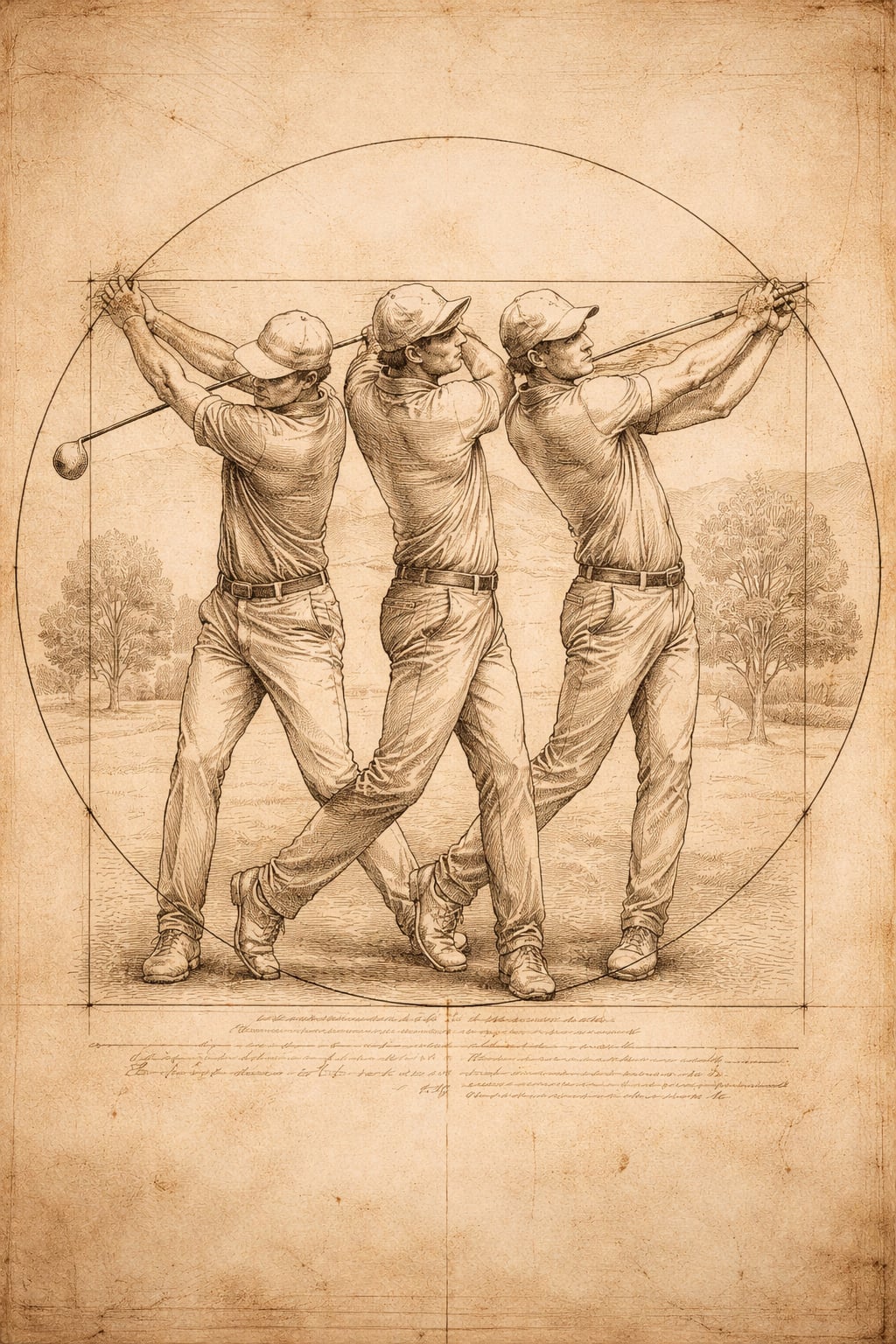
From Bobby Jones to Nelly Korda, Hogan to Bryson, the golf swings that pass the eye test, and what beauty actually measures when a person, an instrument, and a piece of land all line up for one motion.
There is a moment, somewhere between the first light breaking over a dew-soaked fairway and the long shadow of late afternoon stretching across the 18th green, where golf stops being a sport and becomes something else entirely. Something closer to a painting. Something closer to memory. If you've ever stood at the edge of a course at dawn, mist still hovering just above the grass, the smell of earth and cut turf hanging in the cool air, you understand that this game was never just about the ball. It was always about the place it takes you, and the way someone moves through it.
The art of the golf swing is simply that: art. Not a technique. Not a sequence of biomechanical checkpoints. Art. The kind that makes you stop mid-bite of your hot dog and forget you were even hungry.
The Courses Themselves Before we talk about the swing, let's talk about the stage it's performed on, because the two are inseparable.
Augusta National in April is an argument that the world is, on balance, good. The azaleas blooming pink and white against the Georgia pines, the immaculate green turf, Amen Corner sitting in the late morning light like a place designed by someone who wanted to test not just your golf game but your soul, it is one of the most visually stunning environments in all of sport. Pebble Beach exists on the edge of the Pacific Ocean like a dream someone had and then, impossibly, built. The 7th hole at Pebble, a tiny par-3 with the ocean practically lapping at the green, is less a golf hole and more a dare. St. Andrews in Scotland, the birthplace of the game itself, sits under skies that seem to rotate through four seasons in a single round, and standing on the first tee with the town behind you and five hundred years of history beneath your feet is the kind of thing that makes you want to call someone you love and tell them about it.
These are the stages. These are the cathedrals. And the swings that play out on them have always carried the weight of that setting, because when you play in places that are beautiful, the standard rises whether you ask it to or not.
Golf has been played since the 15th century on the linksland of Scotland, where the wind came off the sea and the ground was firm and the game demanded creativity, patience, and a philosophical relationship with bad luck. The game never left that spirit behind. Every course in the world that earns the adjective great earns it by honoring that original truth: a piece of land that tests you not just physically but mentally, surrounded by the natural world in all its indifference and beauty.
That is the context in which every golf swing in history has been delivered.
Hollywood, Jones & Hogan, the Swings That Mean Everything Hollywood figured this out long before the rest of us admitted it. When they set out to make The Legend of Bagger Vance, they didn't just need an actor. They needed someone who could embody Bobby Jones, one of the most beautiful swings ever recorded on film, because a golf swing that doesn't look right pulls you right out of the story. You feel it when it's wrong the way you feel a missed note in a song you love. The search for someone who could carry that swing on screen was, in its own way, a tribute to how sacred the motion itself had become.
Bobby Jones retired at 28 having won the Grand Slam, all four major championships in a single calendar year, and never turned professional. He played the game for love and for the sheer pursuit of something close to perfect, and the footage of him swinging a golf club in the 1920s and 30s still stops people cold today. Fluid, long, with a hip turn so complete and a finish so full that you forget for a moment that equipment in those days was made from hickory and that the courses were far rougher than anything we play today. The swing transcended its era. That's how you know it was something special.
Nobody has made a movie about Ben Hogan yet, and perhaps that's for good reason. Because Hogan's swing, precise, violent, and somehow deeply private, might be the hardest thing any human being has ever done with a golf club to replicate. It would be like asking someone to forge a Stradivarius from memory. Hogan rebuilt his swing from scratch after a near-fatal car accident in 1949, returned to win six more major championships, and wrote Five Lessons: The Modern Fundamentals of Golf, which remains the most influential instructional book the game has ever produced. His swing was not beautiful the way Jones's was beautiful. It was something more austere than that. It was the visual expression of total, absolute mastery of self, every variable reduced, every compensation removed, every movement stripped down to pure functional precision. Watching Hogan swing a golf club was watching a man who had decided he would not be at the mercy of anything, ever again.
Matt Damon and Shia LaBeouf carried their weight beautifully in Bagger Vance & The Greatest Game Ever Played, further into grace than the awkward, wonderful chaos of Happy Gilmore or CaddyShack ever dared to reach. There's a reason we love Happy, we've all felt like Happy, but we watch Bagger Vance and feel something quieter, something reverent. We're not laughing. We're leaning in.
The Swings That Were Earned The real-life swings of Tiger Woods, Rory McIlroy, and Adam Scott belong in that same sacred category. They are not arrived at... They are earned, built painstakingly through ten thousand hours of repetition, of quiet mornings and aching evenings, of standing on a range alone with a bucket of balls and the kind of commitment most people reserve for things far more serious than a game. What you see on Sunday afternoon is the surface of something much deeper, like looking at a lake and trying to imagine the riverbed beneath it.
Tiger's swing has been rebuilt multiple times over the course of his career, each version tuned to a different chapter of his body and his ambitions. What stayed constant through every iteration was the intention behind it, full, complete, and designed to be deployed under the highest possible pressure without flinching. In his prime, there was a particular move through the ball, a dropping of the club on the downswing followed by a controlled explosion through impact, that instructors have spent decades trying to teach their students, with almost universal failure. You don't teach a student that move. A student arrives at that move after years of work and the specific physical gifts that only one person in the history of the game ever combined in exactly that way.
Rory McIlroy's swing is the most aesthetically pleasing action in the modern game. He generates clubhead speed through rotation with such efficiency that it seems almost impossible the ball could travel as far as it does, and yet it does, with a shape and a sound that turns heads on driving ranges across the world. He has made adjustments over the years, the most dramatic of which happened when he retreated to a simulator and tore the whole thing apart before reassembling it into something even better. The willingness to do that, to voluntarily break something that was working in search of something that might work better, is its own kind of genius.
Adam Scott remains one of the most effortlessly complete swings in the professional game. Tall, measured, with a tempo so smooth it almost seems like it's playing at three-quarter speed even when it isn't. Adam Scott swings a golf club the way a great conductor leads an orchestra: everything in its place, nothing wasted, the result somehow larger than the sum of its parts.
The Swings That Were Simply Born And then there are those whose swings feel like they were simply born into the world, swings that don't announce themselves but arrive the way a warm breeze does: unexpectedly, and welcome. Freddie Couples. Vijay Singh. Ernie Els. Jake Knapp. These are players who never seemed to be fighting the club, never seemed to be searching for distance. They found something most golfers chase their entire lives and never catch: the knowledge of themselves. Their strengths, their tendencies, their limits. They didn't need to swing as hard as humanly possible because they already knew where they were going. There is a profound peace in that, and it shows in every single tempo. Watching a Freddie Couples swing is like watching someone arrive home.
Ernie Els earned the nickname "The Big Easy" not from a publicist but from the galleries who watched him and simply couldn't believe that something that large could move that softly. Six-foot-three, broad as a doorway, and yet the swing unfolded like a piece of music, gradual, inevitable, unhurried right up until the moment of impact when the ball left the face with a crack that reminded you the softness was always an illusion. He was never soft. He was controlled.
Seve Ballesteros deserves his own paragraph in any conversation about beautiful swings, not because his swing was the most technically correct, it wasn't, and he knew it, but because no one who ever watched Seve play forgot it. He played golf with a creativity and a flair that suggested the rules of the game applied to everyone else slightly more than they applied to him. Car parks. Television towers. Bunkers that looked like they were designed specifically to be unplayable. Seve played from all of them and made the gallery gasp every time, with a swing that had fire in it, instinct in it, a kind of defiant joy that you won't find anywhere in a technique manual. When Seve hit a golf ball, you always felt like you were watching someone who loved the game more than the game deserved.
Nelly Korda has brought that same effortless dominance to the women's game, a swing so balanced and powerful that it is reshaping conversations about what is possible at the top of the LPGA. Her action through the ball is a masterclass in sequencing, and watching her compete is a reminder that the eye test has never had a gender requirement. A beautiful swing is a beautiful swing.
The Scientists and the Artists Tiger famously said to swing as hard as you can and sort out the consequences. And he could. He could sort out anything. But that was Tiger, and there is only one of those, a force of nature so singular that the rules he played by don't translate to the rest of us mortals. Then there is Bryson DeChambeau, who looked at the beauty of the golf swing and decided beauty wasn't the point. He brought math, physics, and what can only be described as maximum effort, Deadpool would be impressed, and perhaps slightly confused, turning the swing into a laboratory experiment in search of maximum speed and maximum distance. There is something fascinating about Bryson, even if watching him set up over a ball feels less like watching art and more like watching someone prepare to launch a satellite.
Dustin Johnson sits somewhere between these two worlds. His swing, by every conventional measure, is technically incorrect, the clubface at the top of his backswing points almost directly at the sky, a position that any teaching professional would quietly correct in a weekend golfer, and yet through sheer athleticism and timing he squares it at impact with such consistency that he has won 24 PGA Tour events and a major championship. DJ is proof that the eye test is not a rulebook. It's a feeling. And the feeling you get watching Dustin Johnson, even if you can't fully explain the mechanics, is one of raw, barely contained athletic power arriving at exactly the right moment.
Jon Rahm is the spiritual heir to Seve in terms of competitive fire, though his swing is considerably more orthodox. He plays with an intensity you can see in his posture before he even takes the club back, a coiled readiness, an impatience that somehow becomes patience at the exact moment it needs to. Rahm is not watching the scenery. Rahm is hunting.
The Beauty Beyond the Swing But here's the thing about golf: the beauty isn't only in the swing. The beauty is in everything that happens after the swing doesn't go exactly the way you planned. Which is most of the time. Which is, quietly, the point.
Golf is played outdoors. This sounds obvious until you stop and really sit with it. Every round you've ever played happened underneath a sky that was never the same twice. You've walked in morning fog and afternoon heat. You've made bogeys in the rain and birdies in the golden hour when the sun turns everything amber and the shadows go long and the world seems to slow down just enough to let you feel it. The course doesn't care what you shoot. The oak tree on the 14th has been there longer than the golf course has, and it will be there long after the last scorecard is filled out. Standing next to something that old, with a seven iron in your hand and a decision to make, is its own kind of communion.
There is a particular quiet that exists on a golf course in the early morning that you cannot find anywhere else. Not silence, the birds are there, the wind is there, the occasional distant sound of a club striking a ball carries across the fairways, but a specific, inhabited quiet that feels like the world taking a breath before the day begins. To walk through that quiet for three or four hours is a thing that is hard to explain to someone who hasn't experienced it, and immediately understood by anyone who has.
And within that communion, within that wide-open natural world, the game offers something it never quite advertises: creativity. The solution. The imagination of recovery.
Watch Bubba Watson navigate a golf hole and you are watching someone think in a language that most people have never learned. He sees angles and trajectories and possibilities that exist nowhere except in his own mind, and then, this is the part that makes you grip your armrest, he executes them. Watch Jordan Spieth in a bunker, the ball buried, the lip steep, the green running fast, and you will hear the whole gallery hold its breath because the shot looks, from every rational angle, impossible. And then the door opens. The ball comes out. The crowd exhales. The fan at home thinks: where was he going with that? What was he thinking? How did he even see that shot? Phil Mickelson spent a lifetime asking that same question of himself, and answering it. The way Lefty could open the face of a wedge and manufacture a shot from the tightest of lies, from hardpan or rough or the gnarliest bunker lips on the planet, was less short game and more sorcery. He didn't just get the ball close. He got it close in ways that made you wonder if he was operating under a different set of physical laws than the rest of us.
That question, how did they even see that?, is one of the great gifts golf gives its watchers.
The weekend golfer sees six inches of daylight between branches from 180 yards out and feels, somewhere deep in their chest, the pull of possibility. They know it's probably not a good idea. They've been here before. They know what happened last time. And yet. There is something in the game that keeps pulling you toward the shot you shouldn't try, because occasionally, rarely, gloriously, you pull it off. You flush a six-iron through a gap that should have swallowed it, and it rises and draws just so and lands soft and you stand there for a second not quite believing that your body did that. The ones on television pull those shots off regularly. But the reason you understand what you're watching is because you've felt the wanting of it.
What the Eye Test Really Measures The beauty of the golf swing doesn't require a handicap to appreciate. It doesn't require you to understand the mechanics of a late release or the physics of clubhead speed. You can be someone who has never set foot on a golf course in your life and still feel something when you watch a truly great swing. There is rhythm in it, and grace, and the unmistakable sense that a human being has figured out, at least for this one moment, how to move in perfect harmony with the world around them.
The eye test is not about technical correctness. It never was. It's about something that is harder to name and easier to feel, the sense that a person and their instrument and the land beneath their feet are, for one brief motion, perfectly aligned. It's the visual equivalent of a song that gets the key change exactly right. You don't need to read music to feel it land.
The game is played in the most beautiful places on earth, through the change of seasons, in every kind of light. It rewards patience. It punishes arrogance. It asks you, every single time, to know yourself, your strengths and your limits, and then invites you to push just slightly beyond them. The professionals who have passed the eye test most consistently over the longest time are not always the ones who hit it farthest or scored the lowest. They are the ones who found, within their own particular set of abilities, a way to move through this beautiful, maddening, extraordinary game that looked like it was exactly what they were born to do.
You don't have to love golf to love the golf swing. You just have to be someone who recognizes, when you see it, that something true is happening.
And once you've seen it, really seen it, felt it in the chest the way a great piece of music hits you, you'll be looking for it every time.
Written by
Barrett Edri
Co-Founder, Foresome