
The Swing, Eye Test: Part 3 (The NBA Only Edition)
Barrett Edri
May 13, 2026
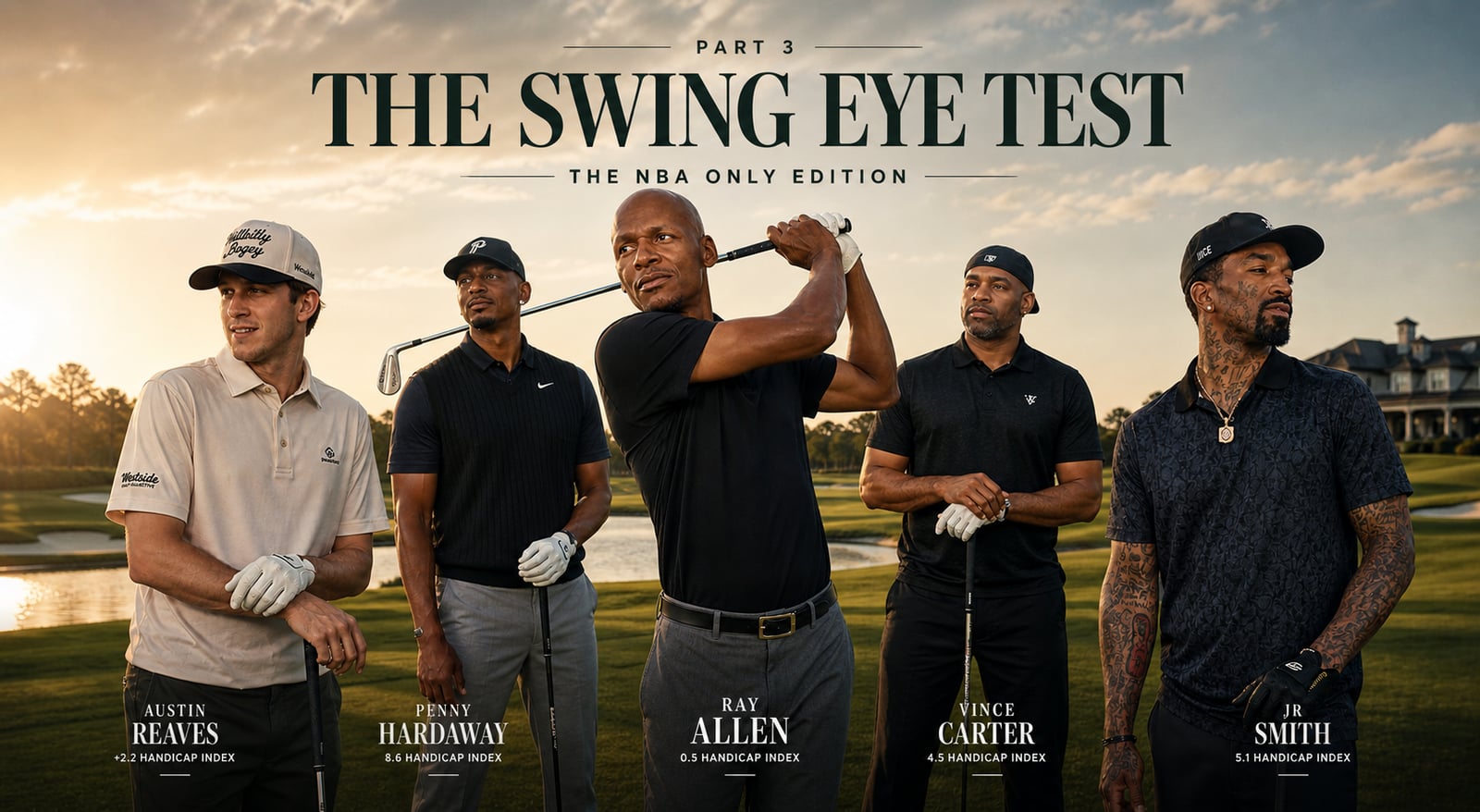
The basketball-to-golf pipeline made it past celebrity status a long time ago. These are the five NBA players who took the obsession furthest, and what their swings actually say.
Something is happening in the NBA locker room, and it has been happening for long enough now that it deserves its own examination.
It started quietly, the way these things usually do. A few players spotted at charity pro-ams in the off-season, the occasional interview where a guy mentioned he had been spending his summer on the range, a handicap number here and there that raised an eyebrow. But somewhere along the way the trickle became a current, and the current became something undeniable. The NBA has produced, in the last two decades, a pipeline of golfers so legitimate, so genuinely skilled, that the conversation is no longer about celebrity golf. It is about golf, period. About players who would compete respectably in any amateur field, who have put in the hours and the reps and the quiet work that actual golfers put in, and who have arrived at the game with the same competitive hunger they brought to the hardwood.
The basketball-to-golf pipeline makes sense when you think about it. The arguments were laid out in Part 2 of this series. The height, the flexibility, the hand-eye coordination trained to its absolute outer limit, the understanding of footwork and rotation and touch that basketball builds in a body over a career. But the NBA specifically has produced something beyond athletic crossover. It has produced a culture of genuine golf obsession, a locker room conversation that never stops, a competitive ecosystem where players quietly track each other's handicaps the way they used to track each other's scoring averages.
These are the five NBA players who have taken that obsession furthest. Five completely different stories. Five completely different relationships with the game. All of them are worth knowing.
- Ray Allen: The Gold Standard There is a version of this conversation where Ray Allen is not the first name on the list. There is a version where the numbers of the other players on this list. The plus handicaps, the professional qualifiers, the audacious claims of superiority. Push him down a spot or two. There is that version of the conversation.
It does not exist. Ray Allen is the gold standard of NBA golf, and the case is not close.
Allen began playing golf in college in 1994 and started getting serious about it in his fourth or fifth year in the NBA, a progression that mirrors, almost exactly, the arc of a player who discovered a second game that demanded the same commitment as the first. He is self-taught. No instructor, no coach, just the game and the range and the relentless repetition that produced, over the course of two decades, a handicap that has been as low as a +1.1. He currently plays to around a 0.5, which means he is better than scratch, which means he shoots in the 60s with regularity at courses where Tour professionals compete. At TPC River Highlands, the site of the PGA Tour's Travelers Championship, he posted a 63 once. He said he should have shot 61. He three-putted twice. He was annoyed about it.
He has four holes-in-one. He plays two and a half times a week on average. When Golf Digest wanted to rank the best athlete-golfers in the game, Ray Allen was the name at the top of the list. When he officially retired from the NBA in 2016, the Golf Digest headline read: Ray Allen Officially Retires From the NBA, Can Finally Focus on His Golf Career. The headline was not a joke.
What separates Ray Allen from everyone else on this list is not just the handicap, as impressive as the handicap is. It is the intentionality. The same quality that made him the greatest three-point shooter in NBA history. The obsessive, systematic, deeply private commitment to repetition until perfect becomes repeatable. It is exactly what made him this good at golf. He said himself that golf helped him focus on his basketball game, that as he started to realize how good he was getting at golf, it helped him work on the things he needed to work on in basketball. The two games fed each other. The discipline was the same. The result, in both cases, was the same: a level of mastery that makes other people stop and stare.
The free throw line and the first tee are not as far apart as they look. Ray Allen proved it.
- Austin Reaves: The Hillbilly with a Plus Handicap On a Tuesday afternoon during the NBA offseason, Austin Reaves was lying on his couch in Los Angeles. He was bored. He texted his best friend Trent and said: find me a golf event I can play in. His friend sent a screenshot of a Korn Ferry Tour Monday qualifier in Knoxville, Tennessee. Reaves said: screw it, let's go. They got in a truck and drove to Tennessee.
This is, essentially, the whole Austin Reaves story in miniature. Not the golf story specifically, the whole story. An undrafted player out of Oklahoma who carved his way into the NBA on sheer refusal to accept any ceiling anyone placed on him, who turned himself into a reliable starter for the Los Angeles Lakers by doing things the hard way with a grin on his face and a confidence so complete it reads as casual. He called his golf TikTok channel Hillbilly Bogey. He had a signature basketball shoe colorway designed around golf. When asked on a podcast to name the best golfer in the NBA, his answer required no thought: "Me."
The man backs it up. Reaves carries a +2.2 Handicap Index in California, affiliated with the Westside Golf Collective. He played high school golf competitively before basketball took over completely. He shot a 76 in the Korn Ferry qualifier. Missing the cut to advance by 11 strokes, which sounds disappointing until you consider that he was competing against professional golfers on a developmental tour with a last-minute entry and shaking hands on the first tee. He was nervous. He admitted it. He said he loved every second of it. He does not plan to enter another Korn Ferry qualifier, but the fact that he entered one at all, just because he was bored on a Tuesday, tells you everything you need to know about Austin Reaves and the way he moves through the world.
He reportedly hit a 441-yard drive. He asks Steph Curry about his swing every time the Lakers play the Warriors. He idolizes Jordan Spieth for his creativity around the greens, the ability to manufacture shots that other players cannot imagine, the artist's approach to a game that rewards problem-solving over mechanics. If you have watched Austin Reaves play basketball you understand immediately why Jordan Spieth is his guy. They are, in a meaningful way, the same kind of player. Undersized relative to the position, wildly underestimated by everyone except the people who have watched them closely, winning by finding a way when the way is not obvious.
The swing passes the eye test. The attitude passes every other test. Hillbilly Bogey is not a brand. It is a philosophy.
- JR Smith: The Redemption Arc In the fall of 2004, JR Smith was supposed to go to college at North Carolina and play basketball for Roy Williams. Instead, he declared for the NBA draft, went 18th overall to the New Orleans Hornets, and spent the next 16 years winning championships, making shots, and building a professional life that never included a single college credit. It was a different kind of education entirely.
In the summer of 2021, JR Smith enrolled at North Carolina A&T State University as a freshman. He was 35 years old. He was pursuing a degree in liberal studies. He was walking on to the men's golf team. The two-time NBA champion who had earned over $90 million in a professional career was moving into a dorm, going to class, and trying to make the cut at college golf tournaments alongside 20-year-olds who had been playing competitively since they were twelve.
Smith said he decided to go back to school after a conversation with Ray Allen. The thread connects: Allen, the gold standard of NBA golf, talked to Smith, and Smith heard something in that conversation that clarified a direction he had already been moving toward. He had started playing golf about 12 years earlier. He had fallen in love with it the way golfers fall in love with it. Suddenly, completely, and with no reasonable exit available. He wanted to see how far it could go.
The debut was humbling in the way that golf is always humbling for people who are used to being the best in the room. He shot a 12-over 83 in round one and a 7-over 78 in round two, finishing last on the team and 81st out of 84 entries. His coach said he found out that collegiate golf is not easy. Smith said he was nervous in a way he had not expected, that making a 5-foot putt in front of three people was as nerve-racking as shooting a free throw in front of 5,000. That quote is one of the most honest things any athlete has ever said about golf, and it belongs in every conversation about what this game actually demands.
What happened next is the part the story is really about. By his second semester, JR Smith was named North Carolina A&T's Academic Athlete of the Year with a 4.0 GPA. He signed a brand ambassador deal with Lululemon for golf apparel. The first male golfer to do so. He signed with Excel Sports Management for NIL representation. He became, without intending to, one of the most visible figures in the conversation about HBCUs and golf's diversity problem, a two-time NBA champion using his platform to stand on a tee box at an HBCU and say that this game belongs to everyone.
The swing is still a work in progress. That is the point. JR Smith did not walk on to that golf team as a finished product. He walked on as someone willing to be a beginner at something, publicly, at 35 years old, with the whole world watching. That takes a different kind of courage than anything he ever did in an NBA arena. Golf has a way of demanding exactly that kind of courage, eventually, from everyone who falls in love with it deeply enough.
- Penny Hardaway: The Quiet Assassin Penny Hardaway does not talk much about his golf game. He does not have a TikTok channel. He does not call press conferences to announce his handicap. He shows up, he plays, and the golf speaks for itself. Which is, if you know anything about Anfernee Hardaway the basketball player, exactly how you would expect it to go. The man was one of the most effortlessly gifted point guards of his generation, a player whose game looked so natural that people sometimes forgot how hard it was to do what he was doing. The same quality carries to the course.
The details that do surface about Penny's golf game have a way of landing with weight. He hosts the annual Penny Hardaway Memphis District Golf Classic, a charity event now in its seventh year that raises money for youth golf programs and community scholarships in Memphis. A genuine investment in getting underrepresented kids onto courses, not just a vanity tournament. He plays at TPC Southwind, the FedEx St. Jude Championship venue, with custom clubs bearing the Memphis Tigers logo because when you are the head coach of University of Memphis basketball and you are playing at a PGA Tour venue, you represent accordingly. He played in the AutoZone Liberty Bowl Golf Classic. He played in the FedEx St. Jude Celebrity-Am. He plays wherever the game invites him, with the equipment of someone who takes it seriously and the ease of someone who has been doing it for a long time.
And then there is the Collin Morikawa moment. Morikawa, one of the best ball-strikers on the PGA Tour and a two-time major champion, played alongside Hardaway at the FedEx St. Jude Celebrity-Am and came away with a specific observation that carries more weight than any handicap number: "He's really good. He's actually really, really good." A scratch golfer telling another scratch golfer they are good is a compliment. A PGA Tour major champion stopping to specifically note that a celebrity partner is really, really good is a different thing entirely. That is Collin Morikawa. A man who plays with the best players in the world every week, being genuinely impressed. That does not happen by accident.
Penny Hardaway is the name on this list that golf people know and NBA people are still discovering. Both sides of that equation are about to change.
- Vince Carter: Twenty-Two Years, Then the First Tee Vince Carter played 22 seasons in the NBA. Twenty-two. He played for eight teams, scored 25,728 points, made eight All-Star teams, and became one of the most recognizable athletes on the planet on the strength of a dunking ability so extraordinary, so otherworldly in its combination of elevation and creativity, that it earned him the nickname Half Man, Half Amazing. He played until he was 43 years old. He played in four different decades. There is no one in NBA history who has done that, and there never will be again.
When it ended, quietly, during the COVID shutdown, announced on a podcast because the pandemic had taken away the proper send-off he deserved. Vince Carter did what every golfer who has been patiently waiting for permission to play as much as they want does. He went to the course.
The golf story is the retirement story. Carter had been playing throughout his career the way many athletes play. When schedules allowed, when the off-season opened up a window, with the genuine love for the game held in reserve against the demands of a sport that consumed everything for nine months a year. And then suddenly the nine months became twelve, and the window became the whole calendar, and the game that had been waiting patiently was finally allowed to come forward.
Golf Digest noted Carter's retirement by observing that he was two degrees removed by coaching tree from James Naismith, the man who invented basketball. The full arc of the game ran through him. And now, on the other side of it, he runs through the full arc of another game. One that does not care how high you used to jump, does not care about the 2000 Sydney Olympics dunk that the world has not stopped talking about, does not care how many decades you played in or how many points you scored. Golf greets every player equally, on the first tee, with the same indifferent silence. What you bring is what you have.
What Vince Carter brought to the first tee after 22 seasons was something that every long-career athlete eventually arrives at: time. Undivided, unscheduled, gloriously open time. The competitive fire that kept him in the NBA longer than anyone thought possible is now directed at the game that has no retirement age, no final season, no moment where the body decides it has given enough. Vince Carter is not done competing. He has simply changed the arena.
The handicap is still being built. The story is still being written. That is the thing about golf that every NBA player who falls in love with it eventually understands, it does not wrap up neatly. There is no final game, no championship ring, no moment where it is finished. There is only the next round, the next improvement, the next shot at something closer to what you know is possible.
For a man who spent 22 years refusing to believe he was done, that is not a consolation prize. That is the whole point.
The Pipeline Stays Open Ray Allen perfected it. Austin Reaves auditioned for it on a Korn Ferry qualifier because he was bored on a Tuesday. JR Smith enrolled in college at 35 to pursue it. Penny Hardaway hosts charity tournaments for it and makes Collin Morikawa stop and pay attention. Vince Carter spent 22 seasons waiting for enough time to give it everything it deserves.
Five different entry points. Five different relationships with a game that asks everything and keeps no secrets. The basketball court reveals character too, but it reveals it in crowds and under lights and with teammates to share the weight. Golf reveals character alone, in the quiet of a fairway, with no one to lean on and the shot right in front of you.
Every one of these five men has stood in that quiet. Every one of them chose to stay.
That is the pipeline. That is why it matters. Not because NBA players playing golf is interesting as a celebrity novelty, it stopped being a novelty a long time ago. But because the game keeps calling, and the best athletes in the world keep answering, and every time they do, they find out something true about themselves that the sport they spent their career playing never quite got around to showing them.
Golf will do that. Golf always does.
Foresome.com
Written by
Barrett Edri
Co-Founder, Foresome