
The Pipeline, The Calvin Peete Story
Barrett Edri
April 30, 2026
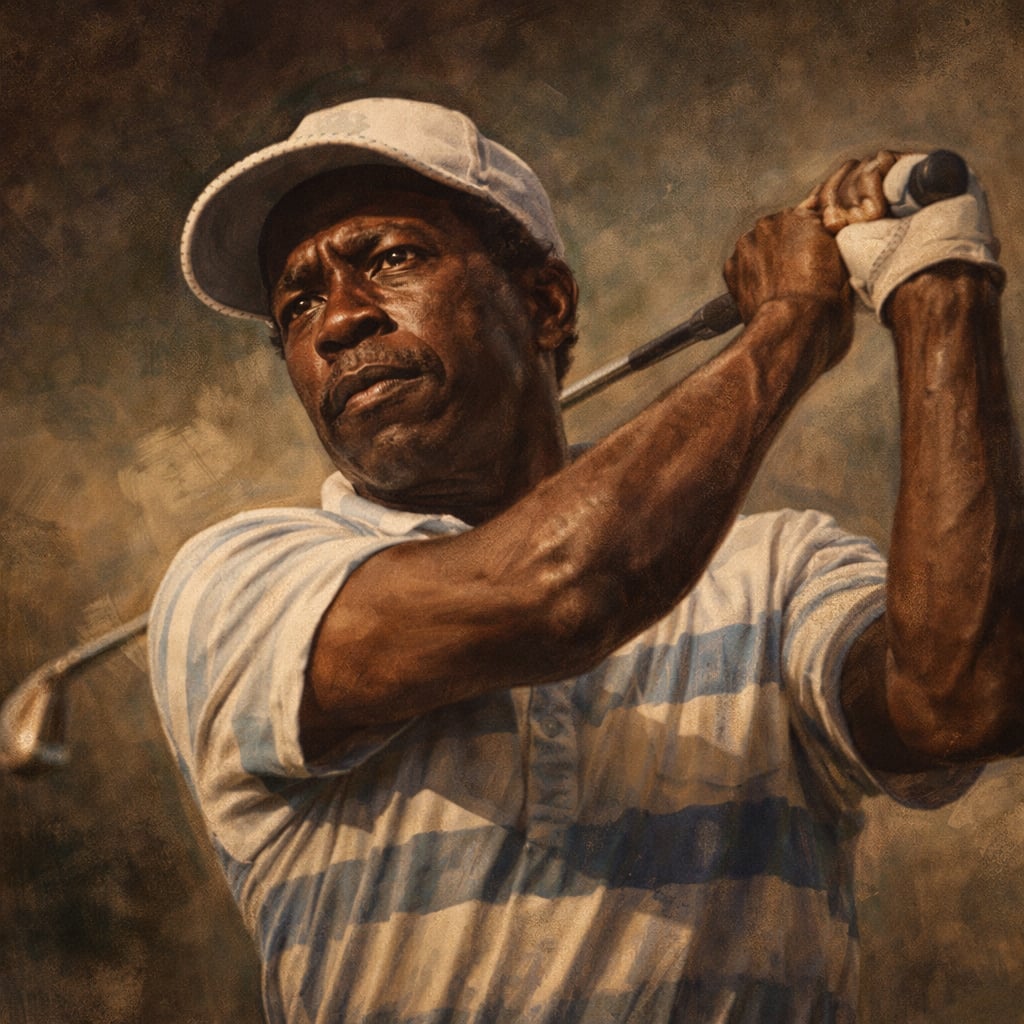
He thought he was going to a fish fry. He ended up being the most accurate driver in the history of professional golf.
Calvin Peete thought he was going to a fish fry. That detail matters because it captures the profound unpredictability of what his life would become. On a summer afternoon in Rochester, New York, in 1966, Peete climbed into a car with friends expecting food, music, and community. He had no reason to believe the day would alter the trajectory of his existence. Instead, the car pulled into Genesee Valley Golf Club. His friends offered him a choice. He could either spend the afternoon waiting for them, or he could pick up a golf club and join. At 23 years old, Calvin had never played golf. He was already a grown man shaped by hardship. Born in Detroit and raised largely in Pahokee, Florida, Peete’s childhood had been defined less by recreation than by resilience. At age 12, he fell from a cherry tree and shattered his left arm. Because his family lacked access to proper medical treatment, the injury healed yet remained permanently deformed. His elbow fused in a way that prevented full extension for the rest of his life. For most aspiring athletes, such a limitation would have closed doors. For Calvin Peete, it became one more obstacle to navigate. He left school after eighth grade to help support his family, working in agricultural fields alongside his father. He built wooden crates for pennies, traveled as a migrant laborer, sold goods from his station wagon, hustled pool, and adapted to every environment that survival demanded. He was intelligent, charismatic, and fiercely independent, yet nothing about his path suggested future PGA Tour stardom. Golf, at that moment, was an entirely foreign world. Yet after those first awkward swings, after the frustration and novelty of his initial round, something in Calvin locked in. When the day ended, he did not walk away. He went directly to the driving range and hit balls until darkness forced him to stop. That was the beginning. Building Greatness Without Permission What followed was one of the most remarkable self made athletic developments in professional sports. Calvin Peete never received formal instruction. He did not emerge from country clubs, elite junior programs, or generational wealth. He taught himself the game almost entirely through obsession, discipline, and study. Ben Hogan’s Five Lessons became his blueprint. Practice became his classroom. He reverse engineered excellence. Within six months, he broke 80. Within a year, he broke par. These milestones alone would be extraordinary for any golfer. For someone beginning at 23, physically limited, financially constrained, and excluded from traditional pipelines, they bordered on incomprehensible. Peete turned professional in 1971 and earned his PGA Tour card in 1975 after multiple attempts at qualifying school. Then came the breakthrough. In 1979, Calvin won the Greater Milwaukee Open, becoming the fourth Black golfer in history to win on the PGA Tour. That victory was not symbolic. It was not ceremonial. It was the arrival of a legitimate elite competitor. Over the next decade, Calvin Peete established himself as one of the finest players in the world. From 1982 through 1986, he won 11 PGA Tour events. His victories included prestigious tournaments such as:
- The Players Championship (1985)
- Phoenix Open
- Miller High Life QCO
- Pensacola Open
- Westchester Classic
- Hawaiian Open The Players Championship, often referred to as golf’s unofficial fifth major, represented the pinnacle of Peete’s career. On one of the sport’s most demanding stages, he defeated the best golfers in the world through surgical precision and unwavering composure. This was not a novelty story. This was sustained greatness. Between 1981 and 1990, Calvin led the PGA Tour in driving accuracy for ten consecutive seasons. Ten straight years. No player in modern history has matched the distinct dominance of that category for such a sustained period. In roughly 1,200 PGA Tour rounds, Calvin Peete hit only one ball out of bounds. One. That statistic remains one of the most staggering markers of precision in sports. His deformed arm, once considered a physical disadvantage, became an architectural advantage within his swing. Because he could not fully extend his elbow, his body developed extraordinary synchronicity. His motion stayed compact, connected, and endlessly repeatable. He transformed limitation into mastery. His success earned him:
- 12 PGA Tour victories
- Multiple Ryder Cup appearances
- Top five finishes on the PGA Tour money list
- The 1984 Vardon Trophy for lowest scoring average
- Recognition as one of the world’s top ranked players For years, Calvin Peete was not merely successful. He was one of the best golfers alive. Character Beyond Competition Calvin’s journey did not end with trophies. In many ways, his larger legacy began after establishing himself. At age 38, already one of the world’s top golfers, Peete earned his high school equivalency diploma to satisfy PGA requirements and to model perseverance for his children. This chapter of his life reveals an essential truth about his character. He did not complain about missing credentials. He acquired them. He did not dwell on structural disadvantages. He transcended them. This same mindset shaped his philanthropic work. In 1989, Peete founded the Calvin Peete National Minority Golf Foundation. Through this organization, he created clinics and developmental opportunities for underprivileged youth, particularly children from communities historically excluded from golf. For Calvin, access to golf represented far more than sport. It represented exposure. Confidence. Possibility. He understood firsthand that the barriers preventing many children from entering golf extended beyond cost. They involved social familiarity, representation, and belief. By introducing young people to the game, Calvin was not simply teaching mechanics. He was widening futures. He inspired countless aspiring golfers, particularly Black athletes, by proving that elite success in golf was attainable even without privilege. Long before diversity initiatives became institutional priorities, Calvin Peete was actively building those bridges himself. The Legacy Golf Still Undervalues Calvin Peete’s place in golf history deserves deeper reverence than it often receives. Before Tiger Woods revolutionized the sport globally, Peete was the most accomplished Black golfer the PGA Tour had ever seen. Charlie Sifford shattered exclusionary barriers. Lee Elder broke Augusta’s racial threshold. Calvin Peete demonstrated that Black excellence in golf could mean dominance, consistency, and statistical superiority. Yet his story often occupies less public space than it warrants. Part of this is because his narrative resists simplification. He did not emerge from polished institutional systems. He was older. Self made. Unconventional. His style and swagger did not always align with country club tradition. He forced his way into greatness on his own terms. That complexity should elevate his story, not diminish it. Today, his legacy offers fertile ground still left underexplored:
- Greater historical recognition within PGA narratives
- Expanded representation in youth golf education
- Deeper study of adaptive biomechanics through his swing
- Continued celebration of self taught athletic mastery
- Broader acknowledgment of his role in expanding minority access to golf Calvin Peete was more than an exceptional player. He was a transformational figure. His life remains a blueprint for resilience, ingenuity, and excellence forged outside traditional systems. The Story Still Growing When Calvin Peete passed away in 2015, the game lost one of its most extraordinary craftsmen. Yet his impact continues. Every young golfer who discovers possibility despite unconventional beginnings walks partially in the path Calvin cleared. Every conversation about inclusion, access, and forgotten pioneers in golf should include his name. Every statistical discussion about accuracy and consistency must eventually return to The Pipeline. He thought he was heading to a fish fry. Instead, he built one of the greatest careers in professional golf history, impacted generations of players, and left behind a legacy that still deserves fuller recognition. Calvin Peete did not simply succeed. He expanded what success in golf could look like. And decades later, the full monument to his life and influence is still being written.
Foresome.com
Written by
Barrett Edri
Co-Founder, Foresome